߲ݴý

Academic Programs Home | ߲ݴý | Academic Programs | Biology Education (Grades 6–12)

Biology Education (Grades 6–12)

Program Info

Degree Type:
Undergraduate
Questions?
(800) 414-5756
Application Deadline
Rolling
Back to Top

Teach Grades 6–12 with TROY's Biology Education Degree

Do you want to teach biology and inspire the next generation of scientists? ߲ݴý University's Bachelor of Science in Education in Secondary Biology Education (Grades 6-12) gives you the tools to become a high school biology teacher or teach at the middle school level. This biology education degree blends a strong foundation in core scientific principles — like genetics, zoology, physiology and ecology — with proven strategies for managing a classroom, planning lessons and using educational technology. You'll learn to teach science in a way that's engaging and effective, then put it all into practice through a supervised student teaching experience that prepares you for certification and the realities of leading your own classroom.

Two biology students observe a sample under a microscope.

The Skills You Need for the Classroom

As a biology education major, you'll go beyond theory to practice the art of teaching. Building on your foundation in the sciences, you'll develop skills in lesson design, lab instruction, student assessment and classroom technology. The program also introduces you to key areas such as educational psychology and science-specific pedagogy, giving you practical tools to connect with students and manage real-world classroom dynamics. With a supervised teaching placement and a clear path to certification, you'll graduate positioned to earn a competitive biology teacher salary.

Expertise in a Variety of Biological Sciences

Get the foundation you need to teach biology — and put knowledge into practice in the lab. At TROY, you'll study biology, cell biology, botany, zoology, ecology and several other sciences, giving you a wide breadth of knowledge you can bring to your future classroom. You'll also take courses in chemistry and math to understand the “why” behind biological processes, be able to interpret lab results and build critical thinking skills. And, you'll learn it all from faculty with a variety of unique expertise and research interests, including coastal shoreline protection, wetland environmental policy, medical physiology, cancer pathology and genetics, plant and animal interactions, and ecological restoration. 

Biology Education Degree Curriculum

While specific courses may vary from year to year, your courses for the biology education degree may include:

Biology Education Academic Catalogs

Students seeking Alabama teacher certification should select biology as a first major and education as a second major. Students should consult with their advisers concerning all certification requirements.


Biology Education Degree Locations

Benefit from in-person instruction and collaboration with peers by taking courses on the ߲ݴý Campus. For more information about program availability and delivery options, call 1-800-414-5756. 

Build Confidence Through Real Lab Experience

As a biology education major, you'll explore the living world in ways that bring science to life — for you and, eventually, your middle and high school students. In the General Ecology Lab, you'll learn how to sample and study ecosystems, from soil and water to plant life and biotic interactions. The Organismal Biology Lab introduces you to the anatomy, life cycles and evolutionary traits of organisms across major phyla. These hands-on experiences are a key part of how to become a biology teacher, helping you build the knowledge and confidence to design lessons, lead classroom discussions and guide future scientists through their own discoveries.
A TROY professor guides students during a biology lab with a live crustacean.

Step into Biology Education Jobs that Make a Difference

With a strong foundation in both science and teaching, you'll be ready to pursue a variety of rewarding jobs in education. You might start as a middle or high school biology teacher, where demand is strong and the biology teacher salary offers potential for growth. You might also choose to become a science lab instructor, STEM program coordinator, curriculum specialist or educational consultant. If you're interested in advancing further, you can build on your TROY biology education degree by earning a graduate degree in biology education or science, opening doors to leadership roles or teaching at the college level.

Faculty Profiles

Janet Gaston

Janet Gaston

Janet Gaston is a lecturer and the advisor of TROY's biology education program. She teaches Principles of Biology, Organismal Biology, and Human Anatomy and Physiology. A two-time alumna, Janet earned both her bachelor's and master's degrees from TROY.
Dr. Christopher Boyd

Dr. Christopher Boyd

Dr. Christopher Boyd is an assistant professor of restoration ecology and the associate department chair in TROY's Department of Biological and Environmental Sciences. He earned his bachelor's degree and Ph.D. from Auburn University and obtained his master's from Clemson University. At TROY, he teaches Principles of Biology, Water Quality and Resources, and Microbiology, among others.
Dr. Joseph Johnson

Dr. Joseph Johnson

Dr. Joseph Johnson is the chair of the Teacher Education Department at TROY. Dr. Johnson is TROY's leader for edTPA preparation and has more than 13 years of experience teaching in secondary schools and 13 more in higher education. He earned his Ph.D. from the University of Nebraska-Lincoln and teaches undergraduate and graduate student teaching seminars.

Chemistry Education Scholarships

Cecile Billy and Katherine Pennington College of Education Endowed Scholarship
This scholarship supports incoming freshmen planning to become teachers after their education at TROY. Award amount varies.
Hennigan/Morris Scholarship
Juniors and seniors studying education can apply for up to $1,500 in scholarship support for their degree at TROY.

FAQ About the Biology Education Program

Learn more about the field of biology education and our program.
What can I do with a biology education degree?

With a B.S.Ed. in secondary biology education, you'll be qualified for careers in biology education, including teaching biology in grades 6–12. You can also explore roles like curriculum specialist, science lab instructor or STEM program coordinator in school or nonprofit settings.

Do I still need certification to pursue biology education jobs?
Yes. Your TROY degree includes courses, labs and student teaching experiences that prepare you for state certification. Our faculty and academic advisors will guide you through the process so you're ready to apply for biology education jobs after graduation. Certification not only qualifies you to teach but also to earn a competitive biology teacher salary with potential for growth over time.
How do I become a biology teacher with TROY's degree?
If you're exploring how to become a biology teacher, the first step is earning a bachelor's degree like TROY's secondary biology education degree. This program combines coursework in subjects like genetics, ecology and pedagogy with a semester of student teaching in grades 6–12. Once you complete the degree and pass any required licensure exams, you'll be eligible for state certification and ready to earn a biology teacher salary or pursue other careers in biology education.

News

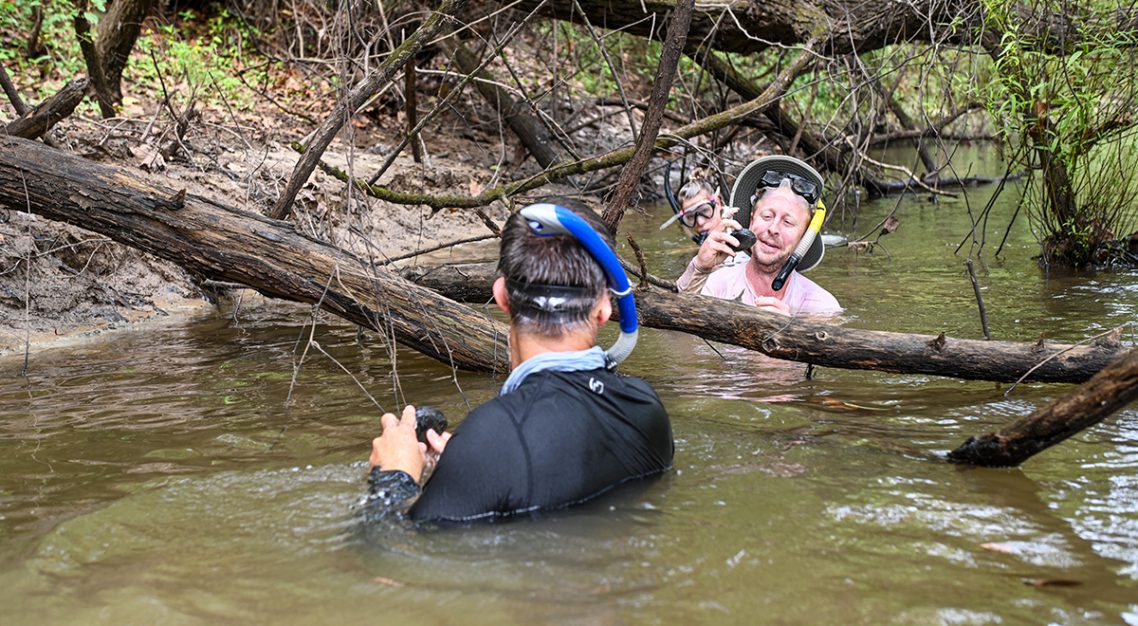
The researchers found multiple species of freshwater mussels in the lower Tallapoosa River.

TROY aquatic biologists search for freshwater mussels in local rivers

Researchers in ߲ݴý University's Department of Biological and Environmental Science recently wrapped up exploring areas of the lower Tallapoosa River in search of three endangered freshwater mussel species in connection with a $54,769 grant from the State of Alabama Department of Conservation and Natural Resources.

INTERESTED IN
APPLYING TO TROY?

Take the Next Step!